Supporting Resources:
Resource 1: Trove Digital Newspapers (National Library of Australia)
Website: https://trove.nla.gov.au
Trove is an invaluable digital archive that provides access to historical Australian newspapers, including articles from the 1850s covering the Eureka Rebellion. Students can explore primary sources such as government reports, miner testimonies, and editorials from publications like The Argus and The Ballarat Times. These sources help students understand how the rebellion was reported at the time and allow them to analyze historical bias and differing perspectives. Using Trove aligns with inquiry-based learning, as students independently investigate how media representation of historical events changes over time. This resource also supports critical media literacy by teaching students how to evaluate the reliability of historical sources. Teachers can guide students in comparing historical newspaper reports with modern interpretations, fostering deeper engagement with historical inquiry and source analysis skills.
Resource 2: Australian History Mysteries – Eureka Stockade Interactive Investigation
Website: https://www.australianhistorymysteries.info
The Australian History Mysteries website offers an interactive Eureka Stockade investigation designed specifically for primary and secondary students. This resource provides a series of historical questions, digital artefacts, timelines, and decision-making tasks that allow students to engage with the Eureka Rebellion as a historical detective. The platform encourages problem-based learning (PBL) by challenging students to analyze evidence, form arguments, and develop conclusions about the significance of the Eureka Stockade. Research indicates that interactive and inquiry-based approaches significantly enhance historical understanding by allowing students to actively construct knowledge rather than passively receive information (Levesque, 2008). Teachers can integrate this resource into classroom discussions where students debate whether the Eureka Stockade was an act of rebellion or a fight for democracy. This aligns with constructivist pedagogy, fostering deep learning, collaboration, and historical empathy, while also promoting higher-order thinking skills in history education.
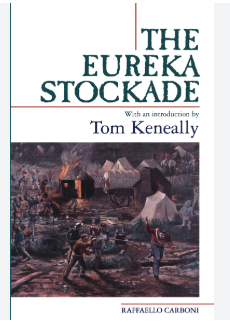
Resource 3: Book – The Eureka Stockade by Raffaello Carboni
Text Resource: Carboni, R. (1855). The Eureka Stockade: The Consequence of Some Pirates Wanting on Quarter-Deck a Rebellion.
Raffaello Carboni was an Italian miner who participated in the Eureka Rebellion and later published this first-hand account in 1855. This book is an essential resource for students to explore personal narratives and miner perspectives. Unlike government records or newspaper reports, Carboni’s memoir provides an emotional and passionate recount of the rebellion, allowing students to compare how different sources portray the same event. Teachers can assign excerpts for students to analyze, encouraging discussions on bias, reliability, and perspective in historical writing. Additionally, this text supports historical role-play activities, helping students authentically engage with the experiences of miners. Research highlights that reading first-hand accounts fosters historical empathy and critical thinking (Seixas & Morton, 2013), making this resource crucial for understanding the diverse viewpoints surrounding Eureka.
Resource 4: Video – Behind the News (BTN): Eureka Rebellion Explained
Website: https://www.abc.net.au/btn/classroom/eureka-stockade/10523010
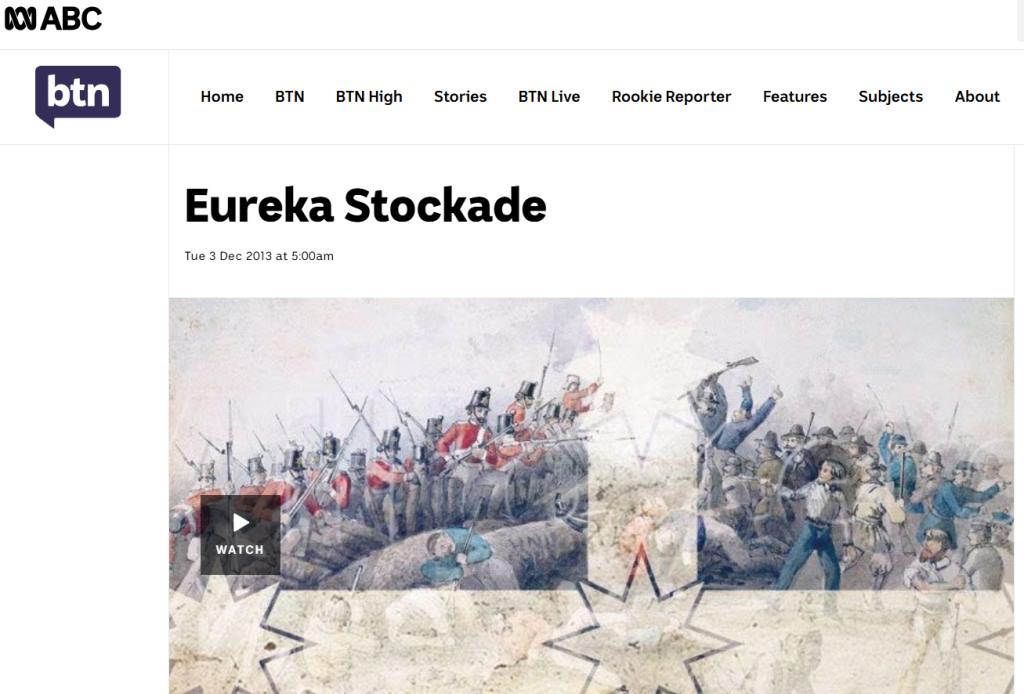
BTN’s Eureka Rebellion episode provides a student-friendly video summary of the key events, causes, and consequences of the Eureka Stockade. The video is visually engaging, using animated storytelling and historical reenactments to simplify complex ideas. It supports multimodal learning by catering to visual and auditory learners, making history more accessible. The resource also introduces historical interpretation by comparing perspectives from different groups involved in the rebellion. Teachers can use the video as a preliminary engagement tool to introduce the Eureka Stockade before students explore primary sources. Studies indicate that visual storytelling enhances retention and comprehension in history education (Wineburg, 2001). Additionally, the video can be used to prompt Socratic seminars on how different media formats influence historical narratives, reinforcing critical thinking and discussion skills in students.